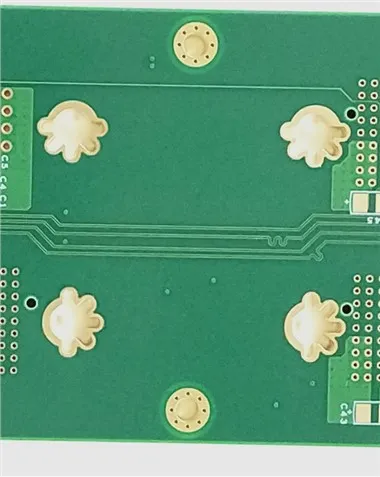


The classification of the printed ciucuit board
Leave a message
The printed circuit board is most fundational part in the electronics devices. it load the electonic components and connect the different circuits, which can be considered as “vest” and “nernus”. It is known as the printed circuit board, and do you know the classification of it.
1.Classification by material
Depending on the material of the substrate, circuit boards can be divided into the following categories:
①rigid circuit board (double sided board): Using glass fiber reinforced plastic (FR-4) as the main raw material, it has good insulation and mechanical properties. Suitable for wiring complex circuits.
②flex circuit board: adopt polyimide, polyamide resin, etc. as the base material. With better high-frequency characteristics, stability, and mechanical resistance, it is suitable for high-end market demand.
2.Classification by copper foil thickness
The copper foil thickness of the circuit board is generally 1OZ, 2OZ, 3OZ, etc. Generally more than 6 layers of complex circuit using 2OZ copper foil. High-end network communication products generally use 3OZ copper foil. 1OZ copper foil is suitable for common household electronics.
3.Classification by layers
①single board
A single board has components on one side only, and a continuous conductive surface on the other side. Single baord is cheap and production costs are low. However, it has serious limitations in circuit wiring, so it is currently widely used in simple situations. Such as single layer LED lamp board, single layer doorbell circuit board, etc.
②Double board
The double-sided board has components on both sides and is connected through holes. In most cases, double-sided boards provide more stable electrical connections and allow for more complex wiring.
③multi-layer board
Multilayer boards are formed by stacking and packaging multiple single layer circuit boards, and interconnected through communication holes between copper foil layers. Multilayer boards are more flexible in circuit wiring than single or double-sided boards, providing higher integration density and superior electrical performance. Multilayer circuit boards have complex production processes and high costs, which are suitable for high-end market demand.