
For the water rinsing of printed circuit board
Leave a message
The water rinsing of printed circuit board is a method of cleaning the manufactured printed circuit board. During the manufacturing process, some chemicals and dust remain on the substrate, which may cause the failure of the circuit or affect the performance of the electronic components.
Therefore,water rinsing can remove these residues by using specific cleaning agents and high pressure water flow, ensuring that the surface of the printed circuit board is clean, thereby improving its quality and reliability.
Printed circuit board is one of the important components in electronic products, which carries the function of circuit connection and signal transmission. In order to ensure the quality and long-term stability of the printed circuit board, it is often necessary to wash the printed circuit board in the process of production.
The water rinsing is to send the printed circuit board that has been printed, gold-plated, or solder resistance into the washing machine for washing. Its purpose is to clean the residual chemical agents and dust on the surface, to ensure that the printed circuit board is completely free of oil dirt, no residue, dry and no water for further treatment.
In the water rinsing process, the printed circuit board will first be pre-cleaned, that is, the board will be put into the cleaning tank, and the copper slag, dust will be washed down by the forced air flow. Next comes the master wash. This step is to make the board in the cleaning tank, by the special pump to sweep the water to wash the surface dirt, emulsion printing liquid, residual glue, etc.. Then it is rinsed, which is mainly to make the board pass the washing tank in a certain time to remove the residual components of the washing water and reduce the interference of impurities on the next process.
It is worth noting that water rinsing requires the use of high-quality deionized water, because deionized water does not contain ions, bacteria and impurities is a necessary condition for the production of electronic printed circuit boards.
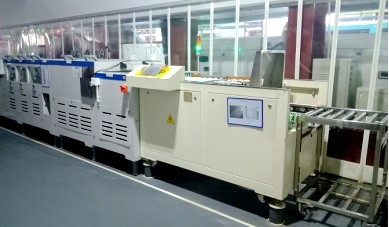
Picture:The production line of water rinsing
The impact of water rinsing on quality includes the following aspects:
1. Removal of residues: The pcb manufacturing process will produce a variety of residues, such as welding residues, oil, dust and so on. If these residues are not thoroughly cleaned off, they can negatively affect the performance and reliability of the board. Board washing can remove these residues, thus ensuring the quality of the board.
2.Avoid short circuit: there are many small circuit connection points on the printed circuit board, and if there are pollutants on these connection points, it may lead to short circuit problems. These contaminants can be removed by washing to avoid the occurrence of short circuits.
3.Ensure the surface finish of the printed circuit board: The surface finish of the pcb has a significant impact on its final appearance and performance. If there are stains and defects on the surface of the printed circuit board, it may affect its final product quality and market competitiveness. Water rinsing can ensure the smoothness of the surface of the printed circuit board.
4.Ensure the electrical performance of the pcb: If there are pollutants and residues on the surface of the board, it may have a negative impact on its electrical performance. By water rinsing, these pollutants and residues can be removed, ensuring the electrical performance of the pcb.
The water rinsing is an important process in printed circuit board production. Compared with other processes, the water rinsing process is relatively simple, but the process has an important role in the quality of the pcb, and is an important guarantee of the high quality of the printed circuit board.